
|
|
I could still feel the ground reverberating beneath my feet. The crash of thunder had split the air with a terrifying explosion. The crackling, ionized air instantly superheated to more than three times the surface temperature of the sun had expanded faster than the speed of sound, rocketed across the mountain face and slammed into me with a force that wrenched at my stomach. The shock wave continued to roll down the valley with an deafening roar. Adrenaline pumped through my veins as my body tensed for the next stroke of what seemed like a giant, invisible sledgehammer.A WEEKEND IN COSTA RICA
Rain splashed against my face and water soaked through my shoes, but I did not notice. Lightening was striking all around us. The flashes of light and accompanying sound blasts pummeled us with such frequency that it seemed only a matter of time before one of the bolts found its mark.
Nervously, I glanced up the face of the mountain on which we found ourselves. I did not know at the time that the peak was helplessly caught in the middle of two vicious storms waging a battle of mythic proportions. Each storm had approached from a different direction and each sought to dominate this prominence. We were pinned down by the crossfire as they strafed the ground around us with high-voltage munitions. While I did not know two different storms raged above us, I did know that all hell had broken loose and turned a pleasant ride on horseback through the Costa Rican countryside into a life and death struggle.
When I glanced back up towards the mountaintop, I could see the field through which Ariane and I had just descended on foot. Our descent had been a reckless plunge down the slippery grass and clay incline. Half-falling, half-sliding, we had scrambled for the relative shelter of the trees at the lower end of the field. Now, covered in mud, we paused and looked back to see if our guides were still with us.
The field above us was partially obscured by fast-moving clouds. Through the mist and crashing thunder I could see our younger guide, Carlos, trying to gather the horses we had been riding. Perhaps responding to a herd instinct, the horses had joined a group of other horses indigenous to this part of the mountain. Together, they were galloping across the face of the slope with Carlos riding his horse in the middle of the stampeding herd. I watched mesmerized as he appeared and disappeared in the clouds like the ghost rider of western lore.
* * *
The weekend trip to Costa Rica was the perfect spontaneous international jaunt. Only a few days before our departure, Ariane had seen the E-saver fare on American Airlines (only $139 round trip) and booked the trip. We left Miami on a 6:40 flight on Friday, October 22, 1999. Only a few short hours later, we were landing at the international airport in San Jose. We breezed through immigration and customs and were soon loaded aboard a courtesy van from our hotel.
As we waited alone in the dark parking lot for other hotel guests to find the van, a stranger approached from behind. "This is an assault," he said. I knew the stranger was using a common transliteration of the Spanish word "asalto" which means "a mugging, " or more loosely "a stick-up." Before, I could react, however, the stranger laughed, told us he was just joking, and went on his way.
The van took us to our hotel, a newly-constructed Marriot very near the airport. After turning off the Pan American Highway, the route to the Marriot passes through a light-industrial area where the visual points of interest are old, rusted warehouses. The Marriot itself, however, is located on an old coffee plantation, and the first hundred yards of the long driveway is lined with rows of coffee plants which still produce the golden beans.
We were shown to room 624 by the night clerk, Miguel, who talked with
us about some of the attractions we could visit over the weekend. Ironically,
he said that he had heard the weather was forecast to be sunny and dry,
even though we were visiting during the rainy season. The room looked out
over the gently rolling landscape that had once been coffee fields. In
the distance loomed the mountains whose tops were perpetually shrouded
in clouds. The room itself was elegantly simple. Massive, solid wood doors
that swung easily on their hinges, gave the room a feeling of old-world
robustness.

That night, after touring the hotel, we took a taxi into downtown San
Jose for drinks. On the way, we became acquainted with our friendly taxi
driver, Marvin Vargas, who agreed to be our driver if we decided to use
a taxi for any day trips.
On Saturday, we were dressed and at the hotel travel agency by 7:30, but it was still closed. We decided to use this downtime by enjoying the hotel's breakfast buffet on the veranda. We returned to the tour office which was open now and discussed various tours with the woman working there. It was readily apparent that it was cheaper simply to arrange the activities ourselves.
Armed with our trusty Fodor's, we went to the hotel concierge for some recommendations regarding places to go horseback riding. He was not the typical concierge. His office was in the business center and he seemed inexperienced in arranging activities for guests. We gave him the telephone numbers listed in Fodor's for horseback riding and he finally found a place that would take us on short notice, the Hotel Chalet Tirol. The man on the other end of the line suggested that we come right away because we should take advantage of the sunny weather.
After a quick change of clothing, we were on our way (with another cab driver, named Robert) to the Chalet Tirol hotel. Nestled in the pines and pastures of the upper slopes of the Barva volcano, this hotel has an Austrian architectural style replete with a replica of a town square with cobble-stone streets. The restaurant features French cuisine (and traditional Parisian aloofness from its staff) which is said to be popular with the locals. Somewhere along the way up the mountain, we left behind the blue skies and sunshine that graced San Jose. At the Chalet Tirol, the skies were overcast, but the clouds were white and, by all appearances, benign.
We were introduced to our guides, Tito and Carlos, who assured us that the horses were gentle and used mostly for children. We had cautioned that we were fairly inexperienced riders, and they responded that they often take entire families with their children on this easy ride. Tito was short, but had the rugged, weathered look of a seasoned mountain man. He wore a floppy fishing hat and a had a hunting knife strapped to his side. Carlos, was taller, a thin, tea-totaling, teenager. Neither Carlos nor Tito spoke English, but both were friendly and attentive.
We started off ambling down a paved road. Within minutes, my horse began kicking his rear legs as if he had a burr under his saddle. Tito had me dismount and he rode my horse for a few minutes without being able to determine what the problem was. We all started out together again without any further problems from my horse.
Our horses clip-clopped along the road, passing children walking in the street, and dogs barking wildly from their yards. At one home, the dogs let us pass only to come out of their yard for a sneak attack from behind. Apparently, Carlos had seen this behavior before and had hung back to head the dogs off when they came out.
The paved road turned to dirt and soon we turned off the road onto a narrow trail that abutted a barbed wire fence. The barbs on this wire were nearly twice as long as I had ever seen and, because this stretch of the trail was so narrow, we were in danger of having our legs gouged when the horses walked to close. We negotiated this stretch, however, without incident.
Soon, we were on another unpaved road - one that had turned to mud from the recent rains. We came to a large ravine which had all the qualities of a slip and slide theme park made of mud. I made it down the steep embankment, but Ariane's horse slipped and fell on its hindquarters. The horse was unhappy about this and became a bit more animated than Ariane's comfort level permitted. As a result, by the time I reached the other side of the ravine, Ariane had chosen to traverse the muddy terrain on foot.
As Carlos and I waited for Tito and Ariane, it began to rain. We pulled on ponchos that had been rolled up and strapped behind the saddles. The rain was relatively light and warm and did not dampen our spirits. We continued up the mountain and into the misty embrace of the clouds. This time Tito walked holding the guide rope to Ariane's horse. We passed through a stand of ghostly-pale trees draped with long strands of moss that glistened in the fog. As we picked our way through the trees, I commented that I really didn't mind that fact that it was raining. The only thing that would bother me would be lightening.
Our ascent became more difficult and at times was so steep that the horses could proceed only by make short hops up the hill. We forged several streams, each one more treacherous than the last. The banks were steep and muddy, and we often had to firmly coax the horses into making the crossing. The horses stumbled through streams littered with jagged rocks as I struggled to stay in the saddle without dropping my camera. Ariane took to walking through the most difficult areas and slogged through knee-deep water with Tito by her side.
Carlos and I (and Tito's horse) reached the trail's summit long before Ariane and Tito. Just as Ariane came into view, a peal of thunder sounded in the distance. Carlos and I waited on our horses while Ariane made the final climb towards us and Tito returned for Ariane's horse which he had left behind at some point. A flash of light lit the clouds around us, and moments later, thunder rent the air. Carlos and I counted the seconds between the lightening and thunder and concluded that the storm was still miles away. By the time Ariane joined us, the flashes were more frequent and the accompanying sonic boom was much closer to the flashes. Being in the clouds, it was difficult to see where the lightening was as it tended to light up the entire sky. Through one brief opening in the clouds, I saw a bolt strike the ground on the other side of the mountain.
At this point, I became concerned that we should take some precautions. I asked Carlos in Spanish, "Isn't it dangerous to be on a mountain top in an open field during a lightening storm." His response was quick and matter-of-fact: "Bastante" (meaning, "Very"). Thinking it over, he said that he would go get Tito. He galloped off telling us to stay put.
Suddenly, Ariane and I were alone on a Costa Rican mountain with nature's fury being unleashed above us. I dismounted and together we led my horse out of the open field to a copse of trees. Within minutes our two guides had joined us, but now the storm was reaching its peak. I spoke with Tito between the crashes of thunder, telling him that I preferred to descend the mountain on foot staying within the trees. Tito also wanted to descend, but thought we should ride the horses through the fields in order to reach safety more quickly. He was insistent and added that there was a house not too far away.
I agreed to go along with Tito's suggestion and we all mounted up. We could not, however, ride quickly across the fields because the mountainside was too steep and slippery. We found ourselves on the exposed face of the mountain as the worst of the storm upon us. Ariane became frozen with fear and crouched in her saddle sobbing. I jumped off my horse and helped her off hers and we began our headlong flight down the hill.
After we were again in the trees and I witnessed Carlos' phantom ride through the sky, we continued our perilous descent. Tito had joined us and we took turns holding Ariane's hand as we clamored down soggy stream beds, over fallen trees, and under fences. The promised house took forever to materialize and when it finally did, the brunt of the storm had passed. From the sound of the thunder, the lightening was not as close, nor as frequent as before. Carlos arrived safely with the horses and we all breathed a collective sigh of relief. It was then that Tito explained that two storms had converged at the mountain top and that, in all his years of experience, he had never seen that before. Later, as we rode back to the hotel, Carlos and I talked about the storm. He said that Ariane had been very afraid. I agreed and told him that I had been afraid as well. Carlos smiled and said that he had never been afraid of a lightening storm - until that day.
Muddy and wet, we looked like death warmed over when we arrived at the hotel. Tito explained to the desk clerk what had happened and admitted that even he had been frightened. After telling our tale and taking pictures with Tito and Carlos, we went to the restaurant for the best meal we had in Costa Rica. It was difficult to tell whether it was the food, or simply the psychological effect of our brush with death.(1)
The hotel was sympathetic about what had happened during our horseback tour. In fact, the tour had been cut short by over an hour. But the hotel did nothing to reduce the cost of our ride, or our lunch. Their primary concern was that we would not ruin the restaurant chairs by sitting in them with our wet clothes. They very happily provided us with raincoats to sit on.
We called our taxi driver, Robert, and he arrived while we were finishing lunch. Even though our trip was cut short, the only thing we felt like doing was going back to our hotel to get out of our wet clothes. Chilled to the bone, we took long hot showers and baths until we were again comfortable. After dressing for dinner, we taxied to the Café Mundo in the Barrio Otoya in San Jose. The place was casual, with good food that was inexpensive.(2) We sat outside and enjoyed the cool, evening air of Costa Rica.
The next day we got up early to another beautifully sunny day in the
central valley. Our original taxi driver, Marvin, picked us up and drove
us into the mountains on our way to Volcán Poás. The Parque
Nacional Volcán Poás is a 22 square mile park protecting
the volcano and the cloud forests on its slopes. The main crater is one
mile across and a thousand feet deep - one of the largest active craters
in the world. The road to the 8,800 foot summit winds through Alajuela,
coffee plantations and verdant pastures. As we ascended this road, the
sun, once again, was eclipsed by clouds. A cold drizzle began and a heavy
wind bent the trees around us.

We stopped for breakfast at a place that specialized in typical Costa
Rican cuisine and scurried inside to get out of the rain. I tried a sugar
glazed roll and hot chocolate, and later ordered a potato hash that was
served with small corn tortillas. Ariane had a fried egg which was sufficiently
crispy after only two attempts. Ariane drank chamomile tea thinking it
was something exotic because we ordered it by its name in Spanish, "manzanilla."
Earlier, I had mistranslated it to mean "apple" ("manzana").

By the time we arrived at the Volcano, the park employee at the entrance
told us not to bother wasting our money because it was so cloudy that there
was nothing to see. Having come so far, we had to see "nothing" for ourselves,
so we paid our twelve dollars, parked, and walked a half mile through the
freezing rain. This time, we did not have ponchos, so our brisk hike to
the crater quickly left us shivering and wet. When we arrived and stood
at the scenic overlook, it was completely white in all directions.
It was supposed to look like this:
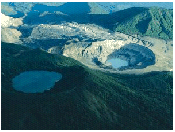
but looked more like this: 
Undaunted, we climbed back in the cab and left for La Paz falls.
The road began to deteriorate as did the visibility in the fog. We were
considering telling Marvin to turn around just when we finally reached
the falls. The cascade was impressive. A huge column of water shot out
from a cliff face that was carpeted with lush vegetation and thundered
into a rocky pool below. The water then rushed beneath an old bridge and
continued down the mountain. A narrow, slippery trail led to a spot directly
behind the falls. From there, the power of this torrent overwhelmed the
senses with its earthshaking roar.


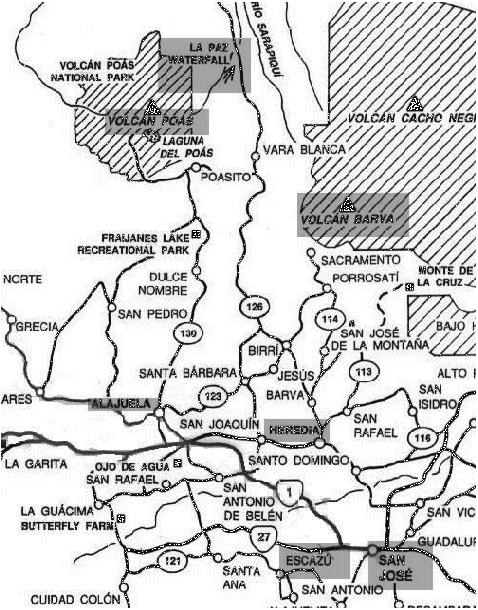
Marvin said that the road beyond La Paz falls was nearly impassible with all the recent rains so we headed back towards our hotel, passing through Alajuela and Heredia. At the hotel, Marvin waited while we changed into dry clothes, and we set out again to explore San Jose.
We found a local place for burgers and fries called, Las Tapias. Ariane ordered a sandwich of Lomito (sirloin) which was much better than my hamburger. My milkshake delicious - thick and heavy on the cream. Ariane ordered a fruit drink, Guayabana.
We then left on a whirlwind tour of the city. We started at the Plaza de la Cultura, where stairs on the eastern end lead down to the Museo de Oro. We passed by the Teatro Nacional and the Parque Central. We saw the Correos (Central Post Office), a building dating from 1917. We also saw the bullet-pocked walls of the Museo Nacional, formerly the Bellavista Fortress dating from 1870. Adjacent to the Museo Nacional was the Plaza de Democracia, a large terraced area built by President Oscar Arias to celebrate 100 years of democracy. The opposite side of the park is occupied by a number of stalls where vendors sell touristy nicknacks. Nearby was the unassuming structure that houses the Costa Rican legislative body. Also nearby was the headquarters for the national police force. This force was created by José Figueres Ferrer when he became the president of the Founding Junta of the Second Republic of Costa Rica in May of 1948 and disbanded the army.
At the western end of Avenida Central was the Mercado Central, a block-long market for farmers and craftsmen, but it was closed on Sunday. To the north was the Museo del Niño (Children's Museum) which occupied a building that was formerly a prison. Finally, we headed southwest outside the city of San Jose to the suburb of Escazú. At the foot of a small mountain range, Escazú harbors an enclave of Americans, and American culture abounds in the form of fast food establishments and other familiar businesses.
Marvin took his cab over roads that cried out for four wheel drive,
until we reached a "mirador" that looked out over the valley. Dissatisfied
with this first stop, Marvin pushed on to the Tara Resort Hotel near the
top of Pico Blanco, the highest point in the Escazú Cordillera.
The main building of the Tara hotel was designed to mimic that of the same
name in Gone with the Wind. We stood on a walled terrace in front
of Tara and absorbed the beauty of the Central Valley.

We returned to the hotel and said goodby to Marvin. We napped before meandering downstairs for dinner in the hotel. Most restaurants in San Jose were closed on Sunday, and, being exhausted, it was no great sacrifice for us to "dine in" at the hotel.(3)
The next morning, we arose very early and rushed to the airport, only to find out that the flight had been delayed an hour because the crew had arrived late last night and needed their federally-mandated "beauty rest." With an extra hour, we had a leisurely breakfast in the airport.(4) We then boarded our flight and arrived in Miami at around 12:30 p.m. Without pause, we went to our respective workplaces, secretly amused that, only that morning, we had been in Costa Rica.
-----------------------------------------------------
1. Ariane had a crepe filled with chicken and mushrooms
in a curry sauce and hot chocolate, while I dined on sirloin tips with
peppers and onions, fries and coffee.
2. Tom complained and sent his tea back. Araine had carrot soup and penne pasta with a light cream sauce and vegetables. Tom had chicken.
3. Ariane had pasta which she sent back twice and
then ended up with a ceasar salad. I had
shrimp. We both had wine and, for dessert, a brownie with ice cream
and hot fudge.